
Eliminating Phantom Power Drain in Electric Vehicles: The Technical Engineering Guide to Stopping Idle Vampire Loss
Author: Faisal Shahzaib | Focus: Quiescent Energy Management & Auxiliary Systems | Standard: SAE Aligned
Eliminating phantom power drain (vampire draw) in modern electric vehicles (EVs) requires systematically resolving the digital and thermal processes that prevent the vehicle’s central computer gateway from transitioning into a low-quiescent-current deep sleep state. While an unmanaged EV can lose anywhere from 2% to 7% of its total state of charge (SoC) every 24 hours while stationary—bleeding 1.5 to 5 kWh of high-voltage capacity daily—a calibrated vehicle consumes under 0.5% per week. Eliminating this energy waste demands auditing four specific subsystems: revoking third-party cloud API tokens that query telemetry through aggressive polling intervals, geofencing active multi-camera computer vision surveillance modes, managing battery management system (BMS) thermal conditioning, and eliminating Bluetooth Low Energy (BLE) proximity wake loops.
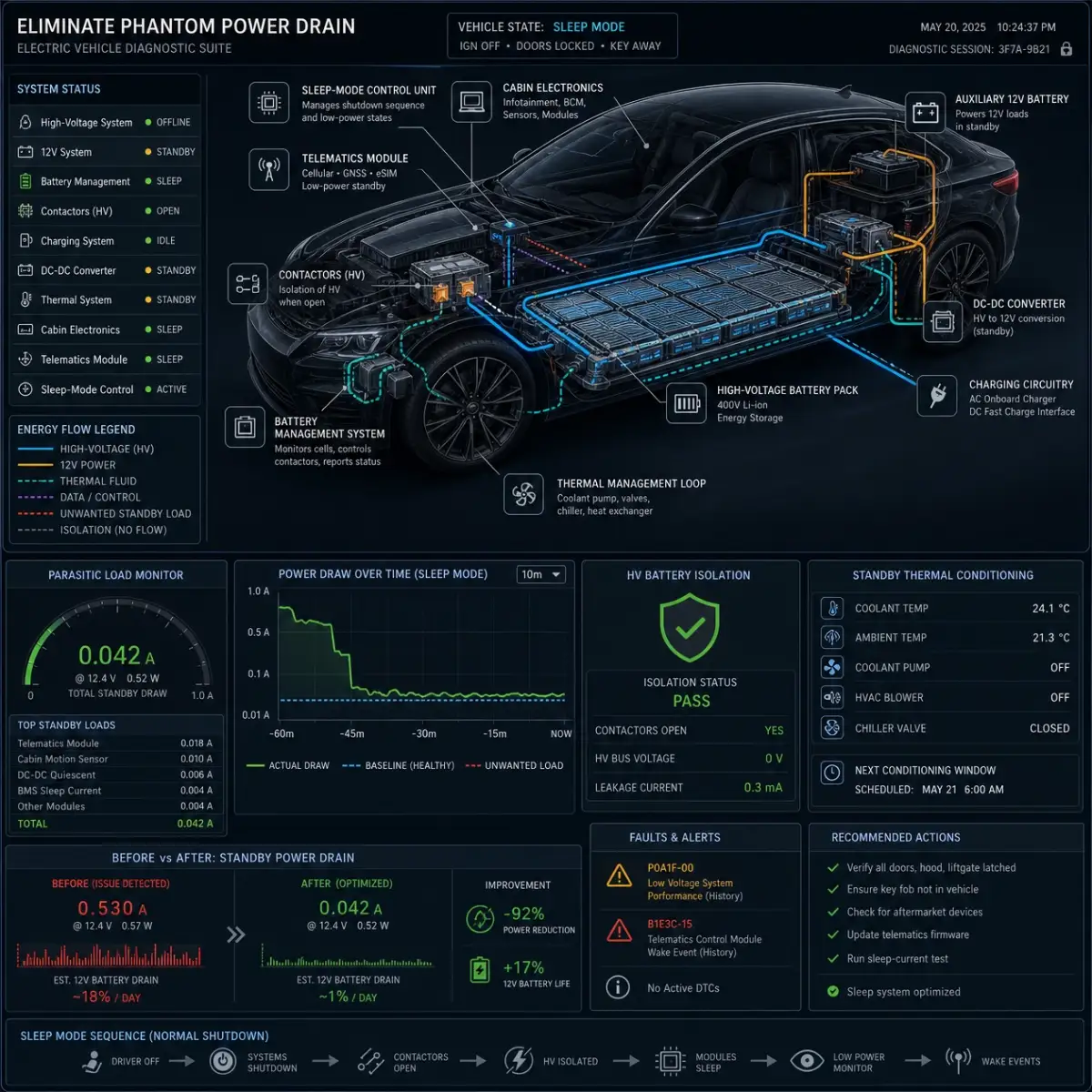
Root Mechanism: How Idle Compute and DC-DC Cycling Drain the High-Voltage Pack
An electric vehicle is not a passive mechanical machine with a physical ignition switch; it is a distributed, networked Linux/Unix computing environment on wheels.
The primary powertrain is driven by a high-voltage (HV) traction battery (typically 400V to 800V). However, all onboard computing units—including the central infotainment processor, telematics control unit (TCU), security camera pipelines, and low-voltage relays—are powered by an auxiliary low-voltage (12V or 16V) subsystem:
Phantom drain occurs when software or hardware triggers continuous wake locks. Sustaining a continuous 250W parasitic draw over 24 hours consumes roughly 6 kWh of energy, burning up to 8% of total vehicle range every single day without moving an inch.
Industry Flaws: What Most EV Owners Get Completely Wrong
- Conflating Phantom Drain with Irreversible Degradation: Owners panic when range drops overnight, assuming lithium-ion cells are degrading. Vampire draw is transient computing and thermal consumption; electrochemical health (SoH) remains entirely intact.
- The Compulsive App Refresh Loop: Opening the manufacturer smartphone app multiple times a day sends cellular push notifications that wake the vehicle operating system, forcing contactors to close and resetting sleep timers.
- Leaving Active Sentry Surveillance Running in Secure Garages: Powering neural network inference accelerators inside a private, locked garage is an unmitigated waste of grid power.
Step-by-Step Protocol: Eliminating Parasitic Vehicle Draw
Phase 1: Revoke Aggressive Third-Party API Tokens
Audit connected fleet trackers or driving analysis apps. Migrate from legacy REST-polling apps (which ping the car every 2 minutes) to event-driven direct streaming telemetry architectures that remain silent during park states.
RELATED CLOUD SECURITY GUIDE:
Discover how excessive API permissions create data risks in our analysis on Hidden Privacy Leaks in Everyday AI Automation Tools.
Phase 2: Geofence Active Computer Vision Surveillance
Configure automatic home and work exclusions for Sentry Mode or camera guard systems. Disabling continuous computer vision processing while parked in a secured residential garage saves 1.5 to 2.5 kWh every single night.
Phase 3: Calibrate Cabin Overheat Protection and HVAC Logic
Evaluate whether mechanical refrigeration A/C is required for cabin overheat protection. Set systems to Fan. Only disable entirely in covered structures. Schedule preconditioning exclusively while plugged into grid power.
Phase 4: Isolate Bluetooth Low Energy (BLE) Boundaries
If your home office is within 30 to 40 feet of your parking stall, your smartphone's Bluetooth beacon may hover on the vehicle's wake threshold. Disable background BLE permissions at night or use a Faraday pouch.
Comparative Analysis: Idle Power Consumption Modalities
| System / Feature State | Hardware Modules Active | Average Power Draw | 24-Hour Range Impact |
|---|---|---|---|
| True Deep Sleep Mode | Low-power microcontroller only | 1W to 5W | Negligible (<0.1% per day) |
| REST API Polling (Third-Party) | TCU cellular modem, gateway, RAM | 40W to 100W | 1% to 3% loss per day |
| Active Sentry / Camera Guard | Neural net processors, cameras, SSD | 200W to 350W | 4% to 8% loss per day |
| Cabin Overheat Protection (A/C) | HVAC compressor, blowers, sensors | 1,000W to 3,000W | Up to 15%+ in direct sun |
Critical Edge Cases & Engineering Pitfalls
In sub-zero temperatures (below 20°F / -7°C), the vehicle’s Battery Management System (BMS) autonomously triggers resistive pack heating elements to protect chemistry from lithium plating. Unplugged vehicles in freezing climates consume significant power to maintain pack thresholds. Always keep EVs plugged into Level 1 or Level 2 chargers during extreme cold to let the BMS draw grid power for thermal maintenance.
Master EV Standby Defence Checklist
Authoritative References & Standards
- Argonne National Laboratory (ANL): "Analysis of Idle Power Loads and Auxiliary Systems in Electric Drive Vehicles."
- Society of Automotive Engineers (SAE International): "SAE J2953 - Interoperability Testing of Electric Vehicle Equipment."
Disclaimer: Vehicle engineering insights and power mitigation strategies are provided for technical and educational analysis purposes only. Individual security postures vary based on corporate infrastructure, network topology, and specific workload configurations.

About the Author: Faisal Shahzaib
Faisal Shahzaib is a digital publisher and technical researcher specialising in digital assets, emerging tech trends, and automated systems. He oversees editorial content and publishing operations at Nexibound. Connect with Faisal on LinkedIn or visit his profile page for more insights.