Table of Contents
- The Silent Crisis Beneath Our Feet
- Why Industrial Farming Misses the Mark
- The Science of Regenerative Farming
- Building Soil Organic Matter
- Restoring Biodiversity
- Practical Steps to Transition Your Land
- No-Till Farming Systems
- Cover Cropping Strategies
- Common Misconceptions
- The Future of Food Systems
- Frequently Asked Questions (FAQ)
The Silent Crisis Beneath Our Feet
We often look at the horizon and see vast green fields, assuming the land is thriving. Yet, beneath the surface, a quiet collapse is happening. Decades of heavy chemical use and constant tilling have turned once-vibrant soil into sterile dust. You might not feel the impact of this crisis directly today, but it is felt in the quality of the food on your plate and the rising instability of our weather patterns. The struggle to maintain yields without destroying the land has left farmers and consumers caught in a cycle of depletion. We need a fundamental shift, moving away from extraction toward restoration. The solution isn't found in a laboratory but in the complex, living biology of the earth itself.
Why Industrial Farming Misses the Mark
The industrial model operates on a principle of command and control. We treat soil as a mere medium to hold plants upright, dumping synthetic nutrients to force growth. This ignores the biological reality of farming. When you kill the soil microbiome with pesticides and excessive tilling, you destroy the natural machinery that provides nutrients to crops. This leads to nutrient-poor produce and a massive dependency on synthetic inputs. We aren't just farming; we are mining the soil. This model is economically fragile and ecologically destructive.
The Science of Regenerative Farming
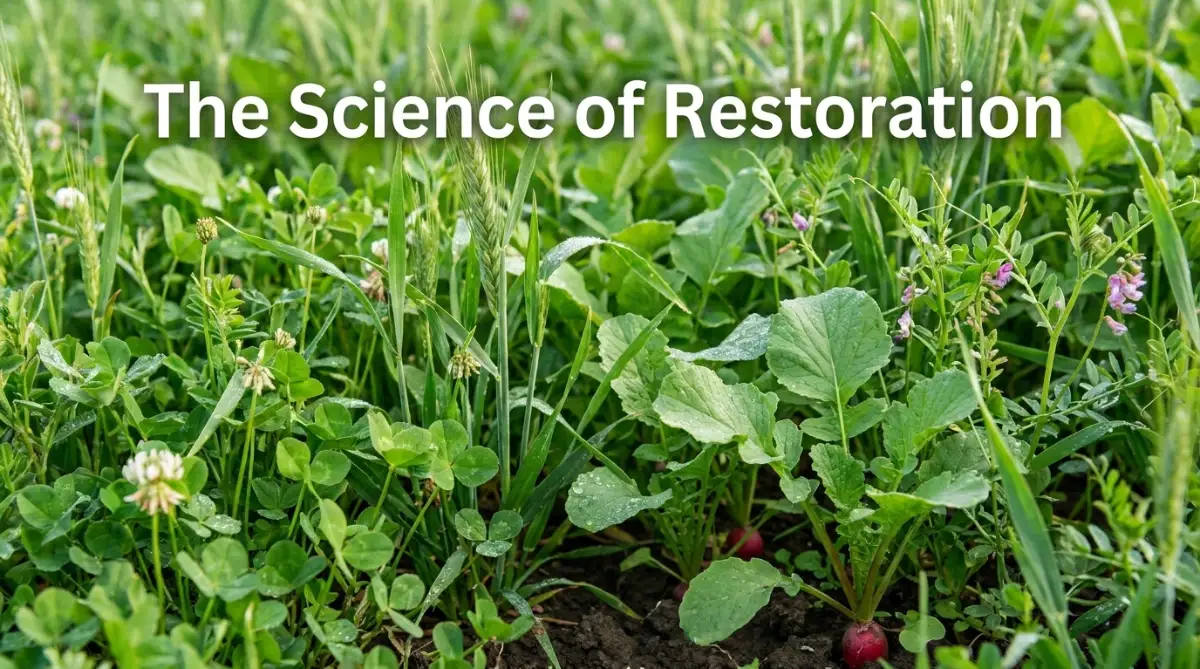
Regenerative agriculture works by mimicking natural ecosystems rather than fighting them. It turns the farm into a self-sustaining loop.
Building Soil Organic Matter
Soil organic matter is the bank account of a farm. It holds water, stores carbon, and provides the architecture for plant roots to thrive. By keeping the soil covered and minimising disturbance, you allow fungi and bacteria to flourish. These microbes essentially "digest" organic material and turn it into stable nutrients for your crops.
Restoring Biodiversity
A healthy farm should look like a jungle, not a factory line. Integrating livestock, rotating diverse crop species, and maintaining hedgerows creates a resilient environment. When you have a variety of plant roots in the ground, you support a wider array of soil life, which protects crops from pests and disease naturally.
Data Overview: Soil Health Impact
Practical Steps to Transition Your Land
No-Till Farming Systems
Tilling is like an earthquake for soil life. It destroys the fungal networks that plants use to communicate and scavenge nutrients. By adopting no-till or reduced-till methods, you leave these networks intact. This keeps carbon in the ground and prevents the massive erosion that typically occurs after heavy rain.
Cover Cropping Strategies
Never leave the soil naked. Cover crops—plants grown to protect the soil rather than for harvest—act as a protective skin. They fix nitrogen, break up compacted earth, and feed the soil microbes during the off-season. Pro-Tip: Match your cover crops to your primary crop’s needs. If your soil lacks nitrogen, plant legumes as your cover crop.
Common Misconceptions

One major myth is that regenerative agriculture cannot feed the world due to lower yields. Research shows that while a transition period exists, the long-term yields of healthy, regeneratively managed soil are often more stable and profitable. Another misconception is that this approach is only for small farms. Large-scale operations are proving that these methods can be scaled effectively to manage thousands of acres.
The Future of Food Systems
The shift toward regenerative practices is no longer a niche hobby; it is a global movement. As we face shifting climate patterns, we need farms that can act as sponges for water and carbon sinks for the atmosphere. The future of agriculture is not about fighting nature but partnering with the biology that makes life possible.
Frequently Asked Questions (FAQ)
- Q: Does regenerative agriculture cost more to start?
- A: There is an initial investment in knowledge and management, but savings on synthetic fertilisers and pesticides often offset these costs quickly.
- Q: How long does it take for soil to regenerate?
- A: Significant biological improvement can be seen within three to five years of consistent management.
- Q: Is livestock necessary for this approach?
- A: While not strictly required, managed grazing by livestock is one of the fastest ways to build soil fertility.
Restoring our land is the most important mission of our time. By focusing on the biological health of our soil, we create a system that feeds the people and heals the planet simultaneously. Start observing your local landscape, learn about local soil health, and support producers who put the earth first. The health of the future starts under your boots.
Medical & Professional Disclaimer
- The content provided in this article is for informational purposes only and is not intended as agricultural, financial, or environmental advice. Always consult with local agricultural extension offices or soil health specialists before implementing new farming practices on your property. Reliance on any information provided here is solely at your own risk.
Author Bio:

Faisal Shahzaib
Faisal Shahzaib is the chief editor at Nexibound and a passionate digital content strategist. He is dedicated to exploring and researching a wide array of topics to bring readers well-verified and engaging information. With a keen eye for digital storytelling and multimedia creation, Faisal ensures that every piece of content on Nexibound meets the highest standards of quality, accuracy, and authenticity.